


Three formats, three levels of intensity. From the sideline they look the same — eight players, one court, lots of swapping around. But the rules differ in one thing each: how partners get decided, and how you win. Get that, and you'll know which to play first. They're also a ladder, so you never run out of next step.
Americano Easiest in | Mexicano Step up | King of the Court Sharpest | |
|---|---|---|---|
| Best level | Beginner-friendly · all levels | Mixed / intermediate | Advanced / competitive |
| Who's your partner? | A new one every round, by a fixed rota | Decided each round by the standings | You hold a partner while you keep winning |
| How you win | Most individual points across all rounds | Most individual points — but on tougher draws | Hold the top "king" court longest |
| Social feel | Easy mixer — you play with everyone | Buzzy and even — games stay close | Loud, sharp, a little ruthless |
| Carries into matches | Consistency & adapting to partners | Reading the game under pressure | Closing out tight points |
Americano
The idea: everyone plays with — and against — everyone. It's the friendliest, most social format, and it works at every level because the field keeps mixing.
How a round works
Players are paired up by a fixed rotation. You play one short round with that partner, then the app reshuffles everyone — new partner, new opponents — and you go again. By the end of the session you'll have partnered most of the room and faced the rest.
How scoring works
You score individual points, not team wins. Each round is played to a fixed target (first to 16 or 21) or a fixed time, and whatever your pair scores is added to your personal tally. Win 16–8 and you bank 16, your partner banks 16. Across all rounds, the player with the most total points tops the leaderboard.
Who it suits
Everyone — and especially newcomers, solo players, and mixed-ability groups. Because partners rotate, a weaker round never sinks your whole night, and you're never stuck. It's the best first format and the easiest way to meet the club.
Every point is yours to keep, so chase every ball — even in a round you're losing. A few extra points off a "lost" game can be what wins you the night.
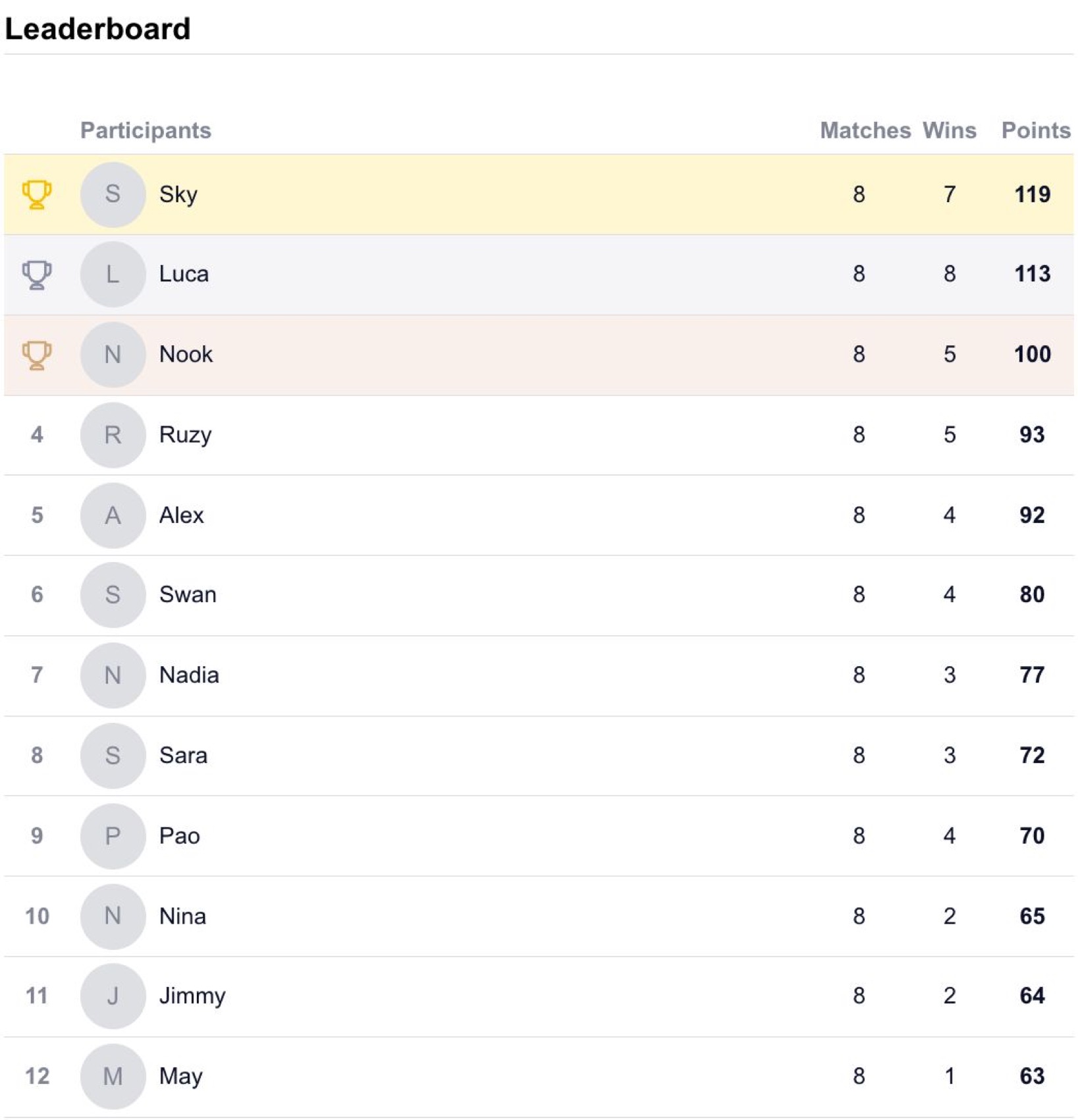
Mexicano
The idea: an Americano with a brain. Same individual scoring, but the pairings each round are decided by the current standings — so the games stay balanced and the matches stay competitive.
How a round works
Round one is usually random or seeded. After that, the app re-pairs everyone by rank: typically 1st + 4th vs 2nd + 3rd on the top court, and so on down the field. Pairing the leader with someone lower — against the chasing pack — keeps almost every match close, right to the last round.
How scoring works
Still individual points to a target or timer, exactly like Americano. The twist is that those points feed straight back into the next draw, so a big round pulls you up the table and into tougher company. Most total points at the end still wins.
Who it suits
Mixed and intermediate groups who want closer games. Because the system constantly balances the draws, nobody runs away with it and nobody gets buried — the gap between the best and the rest narrows every round.
When you climb the table, expect the next game to be harder — that's the format working. Don't panic at a tough draw; it means you're winning. Play steady and let the balance do its job.

King of the Court
The idea: a court ladder. Win and you move up; lose and you drop. At the top sits the "king" court — get there, and you stay as long as you keep winning. It's fast, sharp and openly competitive.
How a round works
Courts are ranked, with the king court at the top. Each round is a quick game. Winners move up a court (or, on the king court, hold their place); losers drop down a court. Partners can hold or shuffle depending on the house rules, but the engine is simple — keep winning and you keep climbing toward the top.
How scoring works
It's not a points-tally format — it's win or lose, every round. Games are short and decisive (a quick race to a number, or a single tight game), because the only question is who goes up and who goes down. The winner of the night is whoever rules the king court when time is called.
Who it suits
Advanced and competitive players who want an edge. The ladder rewards momentum and punishes lapses — every round has real stakes, and the top court gets fierce. It's the sharpest test of the three.
Every round resets — yesterday's king is today's challenger. Win the point in front of you and forget the last one. Short memory, sharp focus: that's how you hold the top court.

The ladder — which to play first
Read them as steps, not rivals. Start with an Americano to get comfortable, meet the room and rack up points with everyone as your partner. Move to Mexicano when you want closer, smarter games where the draw fights to stay even. Then test yourself at King of the Court, where every round is win-or-drop and the top court is yours to defend. Same club, same crowd — you just keep climbing.
Not sure where you sit? Come to an Americano first. Our coaches run the nights and will point you to the right next step — and if you're brand new to padel, that's exactly who these formats are built for.